
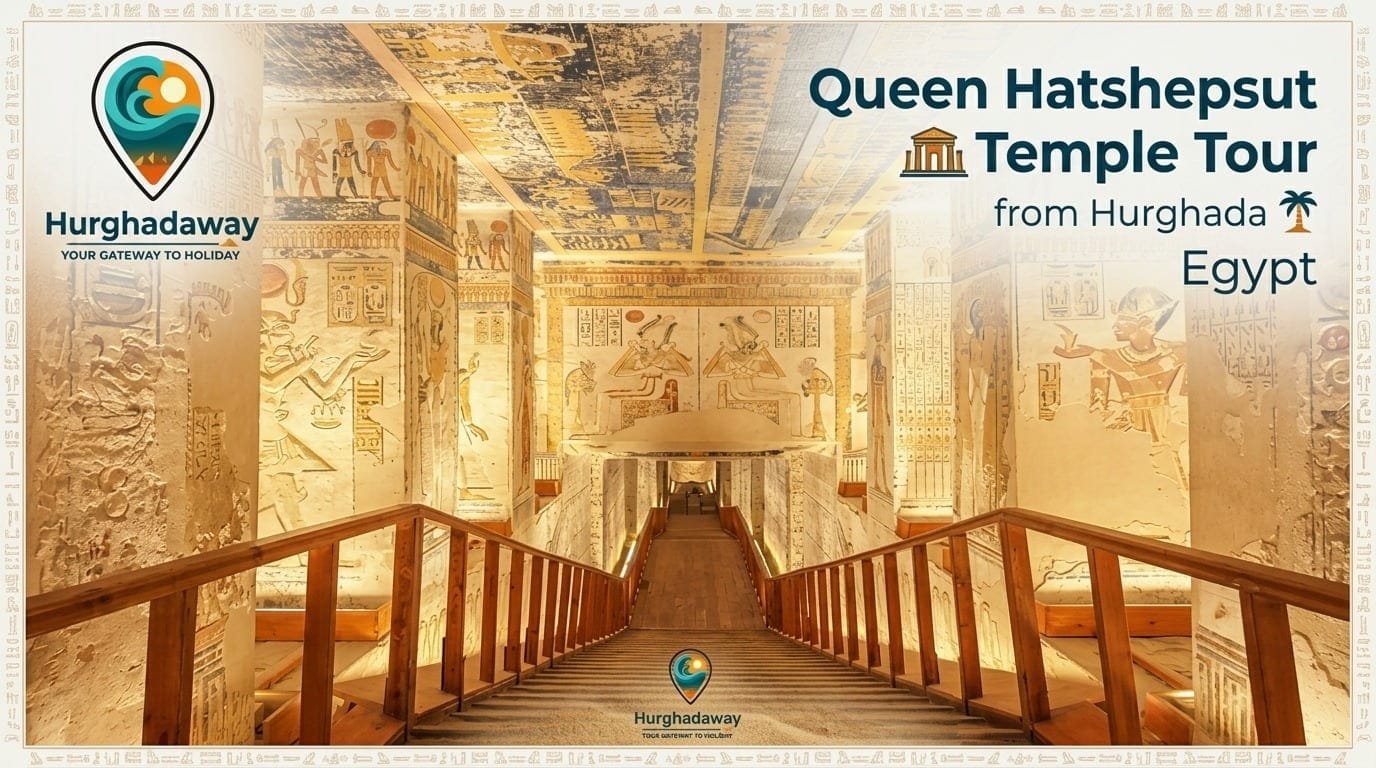
The Queen Hatshepsut Temple Tour from Hurghada is one of the most historically and architecturally remarkable day trips available from the Egyptian Red Sea coast. The Temple of Hatshepsut — known in ancient Egyptian as Djeser-Djeseru, meaning “Holy of Holies” — is the mortuary temple of Hatshepsut, the female pharaoh who ruled Egypt for 22 years (approximately 1479–1458 BC) as one of its most successful and artistically ambitious rulers. Built on the West Bank of the Nile at ancient Thebes, directly against the base of the towering Theban limestone cliffs at Deir el-Bahari, the temple is unique in the entire history of Egyptian architecture: three colonnaded terraces rising in perfect proportional harmony toward the cliff face, decorated with painted reliefs of extraordinary detail and vibrancy that remain among the finest surviving examples of New Kingdom Egyptian art.
Is Hatshepsut Temple worth visiting? Every architect, Egyptologist, and traveller who has stood on the upper terrace of Deir el-Bahari and looked out across the Theban plain toward the Nile has struggled to answer this question in fewer than several paragraphs. The honest answer is that the Temple of Hatshepsut is unlike any other building in Egypt or the world — its setting alone, framed by the vertical limestone cliffs that glow amber and gold in the morning sun, is one of the most dramatic architectural backdrops anywhere on Earth. Add the story of Hatshepsut herself — a ruler whose successor tried to erase her from history and failed — and the temple becomes not merely a monument but a narrative of astonishing human drama written in stone.

Trip Overview — Queen Hatshepsut Temple Tour from Hurghada at a Glance
| Detail | Information |
|---|---|
| Duration | Full day — approximately 13 to 14 hours door to door |
| Pickup Time | 04:00 – 05:00 AM from hotel lobby |
| Return | Approximately 18:00 – 20:00 PM hotel drop-off |
| Languages | English · Arabic · French · Spanish · Italian on request |
| Guide Type | Private licensed Egyptologist — Ministry of Tourism certified |
| Sites Visited | Temple of Hatshepsut (Deir el-Bahari) · Colossi of Memnon · Valley of the Kings |
| Transport | Private air-conditioned vehicle · Hurghada to Luxor 3–3.5 hrs each way |
| Pickup Area | All Hurghada hotels · Sahl Hasheesh · Makadi Bay · El Gouna |
Complete Itinerary — Queen Hatshepsut Temple Tour from Hurghada Hour by Hour


Hatshepsut Temple in Detail — What You Will See and Why It Matters
The Architecture of Deir el-Bahari — A Temple Unlike Any Other in Egypt
The Temple of Hatshepsut (Djeser-Djeseru) was designed by Hatshepsut’s chief architect and likely her closest advisor, Senenmut — a commoner of exceptional genius who rose from humble origins to become one of the most powerful individuals in 18th Dynasty Egypt. The design he created for Hatshepsut’s mortuary temple at Deir el-Bahari was unlike any Egyptian temple built before it: three broad colonnaded terraces rising on a central axis from the desert floor, connected by gently sloping ramps and flanked by side chapels, the entire structure built against and partially cut into the vertical face of the Theban limestone escarpment. The effect is one of perfect integration between architecture and landscape — the horizontal terraces in dialogue with the vertical cliff, the white limestone columns echoing and amplifying the natural fracture lines of the rock behind them.
Is Hatshepsut Temple worth visiting? The architectural historian Dieter Arnold called Deir el-Bahari “the most beautiful building in Egypt.” The Egyptologist James Henry Breasted described it as “the most perfect of all the temples of the land.” Every traveller who has stood before its colonnaded terraces in the morning light — the cliff glowing gold above, the desert stretching to the horizon below — has found their own superlatives insufficient. The honest answer to the question is that no photograph, no description, and no virtual tour can substitute for the experience of arriving at Deir el-Bahari in person, in the morning, with a private guide who can explain precisely what you are looking at and why it matters.
How Much Time Does It Take to Visit Hatshepsut Temple?
How much time does it take to visit Hatshepsut Temple? With a private Egyptologist guide, 60 to 90 minutes is the ideal allocation — sufficient to explore all three terraces thoroughly, examine the Punt Colonnade and Birth Colonnade reliefs in detail, enter the Chapel of Hathor and the Chapel of Anubis, and reach the upper sanctuary with its panoramic view across the Theban plain. Without a guide, most independent visitors complete the same circuit in 30 to 40 minutes — but absorb a fraction of what the temple contains. The difference between a guided and unguided visit at Hatshepsut Temple is particularly pronounced because the narrative content of the painted reliefs is the primary value of the site: the architecture alone is extraordinary, but the reliefs are the temple’s soul, and they are unintelligible without expert explanation.
Who Was Queen Hatshepsut? — The Pharaoh Who Was Erased from History
Hatshepsut — her name means “Foremost of Noble Women” — was the fifth pharaoh of the 18th Dynasty and ruled Egypt from approximately 1479 to 1458 BC. She was the daughter of Tuthmosis I, one of Egypt’s greatest warrior pharaohs, and became his co-regent and then sole ruler during the minority of her stepson Tuthmosis III. What followed was one of the most remarkable reigns in Egyptian history: 22 years of peace, prosperity, ambitious building projects, and long-distance trade expansion that made Egypt wealthier and architecturally more magnificent than it had been in generations.
Hatshepsut commissioned more buildings, statues, and obelisks than any female ruler in history. She organised the famous expedition to Punt that brought back 31 live myrrh trees — the first recorded attempt to transplant exotic trees in history. She erected the two tallest obelisks in Egypt at Karnak (one still stands as the tallest ancient obelisk in Egypt at 29.6 metres). She built her mortuary temple at Deir el-Bahari — universally recognised as the most architecturally perfect temple in Egypt. By any measure, her reign was an extraordinary success.
Yet approximately 20 years after her death, her successor Tuthmosis III undertook a systematic programme of erasure: her images were chiselled from temple walls, her statues smashed and buried, her name excised from inscriptions and replaced with those of her father and husband. For 3,000 years she was lost to history — until 19th-century Egyptologists, piecing together fragmentary inscriptions and half-erased reliefs, reconstructed her existence and restored her to her rightful place as one of Egypt’s most accomplished rulers. The motive for her erasure remains debated by Egyptologists to this day — your private guide explains the competing theories and the evidence for each. The story of Hatshepsut’s erasure and rediscovery is one of the most compelling narratives in the history of archaeology, and it is written — literally — on the walls of the temple you are standing in.

Pricing and Packages — Queen Hatshepsut Temple Tour from Hurghada
Hurghada Way offers the Queen Hatshepsut Temple Tour from Hurghada in two formats. Both include hotel transfers, private Egyptologist guide, all entrance fees, lunch, and bottled water throughout. Contact Hurghada Way via WhatsApp for confirmed current pricing on your specific dates — our team responds within minutes.
Best Time of Year for the Queen Hatshepsut Temple Tour from Hurghada
| Month | Luxor Temp | Crowd Level | Verdict |
|---|---|---|---|
| October – November | 22–32°C | Moderate | Ideal — comfortable heat, golden morning light on the cliff face |
| December – February | 14–24°C | High (peak season) | Excellent — perfect cool weather · book 1–2 weeks in advance |
| March – April | 20–34°C | Moderate-High | Excellent — warm but manageable, vivid desert colours |
| May – June | 30–42°C | Low | Good — hot but manageable with 04:00 AM start · near-empty site |
| July – September | 38–45°C | Very Low | Challenging heat · lowest prices · almost entirely private experience |
October and November produce the finest conditions for the Queen Hatshepsut Temple Tour. The morning light on the Theban limestone cliffs at Deir el-Bahari during these months — warm amber and gold against the pale white of the colonnade — is exceptional for photography, and temperatures on the open terraces are comfortable for extended exploration. The early 04:00–05:00 AM departure from Hurghada ensures arrival at Deir el-Bahari before the cruise ship groups from Luxor, giving your private guide time and space to bring the temple’s painted reliefs to life without competition. At Hatshepsut Temple specifically, the pre-crowd morning window between 08:30 and 10:00 AM is the single most important factor in the quality of the visit.
Related Excursions — Plan Your Complete Egypt Holiday from Hurghada
Historical Day Trips — Luxor · Cairo · Abu Simbel
| Excursion | Duration | Key Sites | Book |
|---|---|---|---|
| Queen Hatshepsut Temple Tour (this page) | Full day | Deir el-Bahari · Colossi of Memnon · Valley of the Kings | |
| Karnak Temple Day Trip from Hurghada | Full day | Karnak · Luxor Temple · Avenue of Sphinxes | |
| Luxor Hot Air Balloon + Temples Tour | Full day | Sunrise balloon flight · Valley of the Kings · Karnak or Luxor Temple | |
| Valley of the Kings Day Trip from Hurghada | Full day | Valley of the Kings · Medinet Habu · Ramesseum | |
| Cairo & Pyramids Day Trip by Air | Full day | Pyramids of Giza · Grand Egyptian Museum · Sphinx | |
| Abu Simbel Day Trip from Hurghada by Air | Full day (by air) | Ramesses II Great Temple · Nefertari Temple · Lake Nasser |
Red Sea Day Trips — Hurghada · Marsa Alam · El Quseir
| Excursion | Duration | Highlight | Book |
|---|---|---|---|
| Giftun Island Day Trip + Snorkeling | Full day | Best coral reef · 2 snorkeling sessions · Lunch | |
| Mahmya Island Day Trip with Lunch | Full day | Premium managed beach · Island restaurant · Reef | |
| Marsa Alam & El Quseir Snorkeling Day Trip | Full day | Dugongs · Manta rays · Pristine reef south of Hurghada |


Expert Tips for Your Hatshepsut Temple Visit from Hurghada
Tip 1 — Book a private guide: it is non-negotiable at Hatshepsut Temple. The Temple of Hatshepsut contains some of the most narratively rich and visually detailed painted relief sequences in Egypt. Without a licensed Egyptologist guide, these painted walls are beautiful but opaque — their meaning, their political significance, and their role in the most extraordinary story of female rulership in the ancient world are simply inaccessible to an unassisted visitor. With a private guide, the same walls become a three-dimensional narrative of astonishing depth. The guide is the single most important investment of the entire day.
Tip 2 — Wear sun protection on the terraces. The three terraces of Deir el-Bahari are partially exposed to direct sunlight, particularly in the middle of the day. The upper terrace in particular — the most sacred and architecturally elevated zone of the temple — faces west and receives full morning sun. Light-coloured, loose-fitting clothing that covers shoulders and knees (for both sun protection and cultural respect), comfortable walking shoes for uneven stone surfaces, sunscreen, a sun hat, and sunglasses are essential regardless of season.
Tip 3 — Photograph the approach before entering. The finest photograph of the temple is taken from the end of the approach avenue — looking straight along the axis toward the three-terraced facade with the Theban cliff rising behind it. This composition is best in the early morning (08:30–09:30 AM) when the cliff is lit and the colonnade is still partially in shadow, creating maximum tonal contrast. Once inside the temple, the most photographically rewarding spaces are the Hathor-headed columns of the Chapel of Hathor and the Punt Colonnade reliefs on the middle terrace.
Tip 4 — Ask the guide specifically about the erasure of Hatshepsut. The evidence for the campaign to erase Hatshepsut from history is written directly on the temple walls in the form of chiselled-out images and overwritten cartouches. Your guide can identify these traces of erasure and explain what was originally depicted — making the walls themselves into a detective story played out in stone across 3,500 years. This is one of the most gripping aspects of any private guided visit to Deir el-Bahari and should not be missed.
Tip 5 — Allow time at the Colossi of Memnon. Many visitors treat the Colossi of Memnon as a brief roadside photo stop. With a private guide, 20 to 30 minutes at the Colossi is time well spent — the guide explains the original temple that once surrounded them (larger than Karnak), the famous Singing Colossus phenomenon that drew thousands of ancient tourists, and the carved side panels (still visible at the base of the statues) depicting the annual Nile inundation. The Colossi seen with context are a very different experience from the Colossi seen as a roadside curiosity.
Tip 6 — Choose your Valley of the Kings tombs in advance. The standard Valley of the Kings entrance opens three tombs. With a private guide, the selection of which three tombs to visit can be tailored to your specific interests — artistic quality, historical significance, or the fame of the pharaoh buried within. The guide recommends the currently open tombs based on your preferences and the accessibility conditions on the day. The tomb of Tutankhamun (KV62) and the tomb of Seti I (KV17) require separate additional entrance fees and are worth the extra cost for visitors with a particular interest in painted decoration.
Tip 7 — No photography is permitted inside the Valley of the Kings tombs. Cameras and mobile phones must be surrendered (or cameras left at the entrance) before entering the tomb chambers of the Valley of the Kings. Photography inside the tombs is strictly prohibited. This rule is enforced consistently. The guide’s verbal descriptions of the painted scenes during the visit are therefore the primary means of absorbing what you see — another reason why the private guide is essential. Sketch pad and pencil are permitted for those who wish to capture details.
Tip 8 — Carry Egyptian Pounds for tips and optional extras. The guide and driver both appreciate gratuities (standard: 100–200 EGP per person for the guide; 50–100 EGP for the driver). Optional additional tomb entrance fees in the Valley of the Kings are payable in Egyptian Pounds at the site. Small souvenir stalls near the temple entrances operate in both EGP and USD — the guide can advise on fair prices. As of June 2026: £1 ≈ 65 EGP approximately.
Tip 9 — Eat breakfast before departure — even at 04:30 AM. A 13 to 14-hour day trip on an empty stomach is challenging at any temperature; in the Luxor heat it becomes genuinely difficult. Ask your hotel to arrange an early pre-departure breakfast (most Hurghada hotels accommodate this with advance notice the evening before). Hurghada Way can also arrange an en-route breakfast stop at a quality roadside restaurant in the desert. Lunch is included in the programme, but the gap between departure and the included lunch is 8 to 9 hours — early breakfast is important.
Tip 10 — Book in advance during school holiday periods. The Queen Hatshepsut Temple Tour from Hurghada with a private licensed Egyptologist guide is consistently in high demand during October half-term, Christmas, New Year, and February half-term. Private vehicle and specific guide availability both require advance booking — ideally 3 to 7 days ahead for standard travel dates, and 1 to 2 weeks ahead for peak periods. Contact Hurghada Way via WhatsApp as early as your travel dates are confirmed to secure your preferred guide language and departure date.
Book Your Queen Hatshepsut Temple Tour Today
Hotel pickup and drop-off · Private air-conditioned vehicle · Licensed Egyptologist guide all day · Temple of Hatshepsut (Deir el-Bahari) · Punt Colonnade · Birth Colonnade · Chapel of Hathor · Chapel of Anubis · Upper Terrace Panorama · Colossi of Memnon · Valley of the Kings · Lunch on the Nile · All entrance fees included. Instant confirmation. Transparent pricing. No hidden costs. Hurghada Way — your trusted local travel partner in Egypt.
Related tours by Hurghada Way:
Karnak Temple Day Trip from Hurghada with Guide
Valley of the Kings Day Trip from Hurghada Egypt
Quad Bike Adventure Hurghada Desert Sunset Safari
Mahmya Island Day Trip from Hurghada with Lunch
Is Hatshepsut Temple worth visiting?
Is Hatshepsut Temple worth visiting? Yes — unequivocally. The Temple of Hatshepsut at Deir el-Bahari is the most architecturally refined temple in Egypt and one of the most dramatically situated ancient buildings in the world. Its three-terraced colonnaded facade set against the vertical Theban limestone cliffs is a composition of breathtaking spatial harmony. The Punt Colonnade and Birth Colonnade painted reliefs are among the finest and most narrative-rich surviving examples of New Kingdom Egyptian art. And the story of Hatshepsut herself — erased from history and rediscovered 3,000 years later — is one of the most compelling human narratives in the history of archaeology. With a private Egyptologist guide provided by Hurghada Way, all of these dimensions become accessible and memorable. The visit is consistently ranked by guests as the single most impactful day trip of their Egypt holiday.
How much is a taxi from Hurghada to Luxor?
How much is a taxi from Hurghada to Luxor? Independent taxis between Hurghada and Luxor typically cost 800 to 1,500 EGP each way (approximately $16–$30 USD at June 2026 exchange rates), depending on the vehicle, driver, and negotiation. However, booking an independent taxi involves significant risks — unlicensed vehicles, uninsured drivers, no guide, and no included entrance fees or lunch. The Hurghada Way Queen Hatshepsut Temple Tour provides a modern insured air-conditioned vehicle, a Ministry of Tourism licensed Egyptologist guide, all entrance fees, and lunch in a single transparent all-inclusive price starting from $65 per person — making it substantially better value than an independent taxi plus guide plus entrance fees calculated separately.
Is the Queen Hatshepsut Temple Tour suitable for children?
Yes — children who have any interest in ancient history, mythology, or adventure stories are consistently captivated by the Temple of Hatshepsut. The story of Hatshepsut herself — a female pharaoh who built the most beautiful temple in Egypt and was then erased from history — is an ideal narrative for young visitors. The Valley of the Kings, with its tomb paintings of underworld monsters and guardian gods, is particularly compelling for older children and teenagers. The Hurghada Way Egyptologist guides are experienced in adapting their explanations for younger visitors from approximately 8 years upward. The primary challenge for young children (under 6) is the length of the day (13 to 14 hours) and the walking on uneven stone surfaces. Children aged 3 to 12 receive 50% of the adult price.