

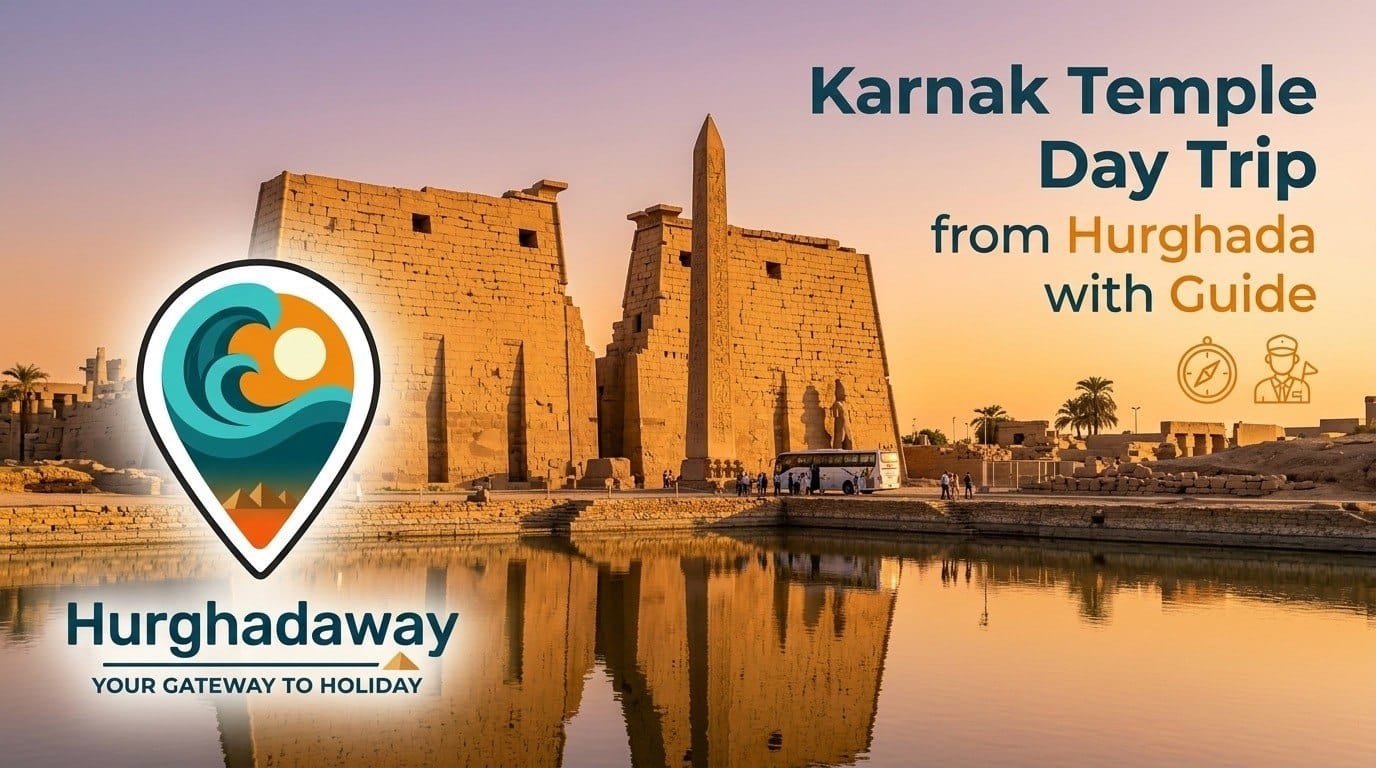
The Karnak Temple day trip from Hurghada is the most historically significant excursion available from the Egyptian Red Sea coast. Karnak is not a single temple but an entire sacred city — the largest religious complex ever constructed in the ancient world, covering 200 acres and containing over 20 individual temples, chapels, sanctuaries, and processional avenues accumulated over 2,000 years of continuous construction by successive pharaohs from the Middle Kingdom through the Ptolemaic period.
Is Karnak Temple worth visiting? Every Egyptologist who has written about Karnak has struggled with the same challenge: no words and no photographs adequately prepare a visitor for the experience of standing inside the Great Hypostyle Hall — 134 colossal sandstone columns, the tallest reaching 24 metres, arranged in 16 rows and covered from floor to ceiling in hieroglyphic inscriptions and painted reliefs. The sheer scale of this single hall — which could contain the entire Notre Dame Cathedral of Paris within its floor space — is the most reliably awe-inspiring man-made experience in Egypt. And it is one component of a complex that also contains towering pylons, sacred lakes, golden obelisks, ram-headed sphinx avenues, and sanctuaries dedicated to the entire pantheon of ancient Egyptian gods.

Is it worth going to Luxor from Hurghada? Without reservation — yes. Luxor contains the highest concentration of ancient monuments anywhere on Earth. In a single day from Hurghada, a traveller with a private Egyptologist guide can visit Karnak Temple, Luxor Temple, and the Avenue of Sphinxes connecting them — experiencing 3,500 years of continuous pharaonic history in one extraordinary day. The 3 to 3.5-hour road journey from Hurghada to Luxor passes through some of Egypt’s most dramatic desert scenery and is an experience in itself.
Trip Overview — Karnak Temple Day Trip from Hurghada at a Glance
| Detail | Information |
|---|---|
| Duration | Full day — approximately 13 to 14 hours door to door |
| Pickup Time | 04:00 – 05:00 AM from hotel lobby |
| Return | Approximately 18:00 – 20:00 PM hotel drop-off |
| Languages | English · Arabic · French · Spanish · Italian on request |
| Guide type | Private licensed Egyptologist — Ministry of Tourism certified |
| Temples visited | Karnak Temple Complex · Luxor Temple · Avenue of Sphinxes |
| Transport | Private air-conditioned vehicle · Hurghada to Luxor 3–3.5 hrs each way |
| Pickup area | All Hurghada hotels · Sahl Hasheesh · Makadi Bay · El Gouna |
Complete Itinerary — Karnak Temple Day Trip from Hurghada Hour by Hour


Karnak Temple in Detail — What You Will See and Why It Matters
The Scale and History of Karnak — 2,000 Years of Construction
Karnak Temple — its ancient Egyptian name was Ipet-Isut, meaning “The Most Select of Places” — is not a single temple but a vast sacred city covering 200 acres (81 hectares) on the east bank of the Nile at ancient Thebes (modern Luxor). Construction began during the Middle Kingdom reign of Senusret I around 2055 BC and continued without interruption through 30 successive pharaonic dynasties until the Ptolemaic period, with each successive ruler adding pylons, columns, statues, obelisks, and chapels to the complex. The result is an architectural palimpsest of 2,000 years of continuous religious building — a place where the theology, politics, and artistic ambitions of 30 successive dynasties are literally layered one upon another in stone.
Is Karnak Temple worth visiting? The French Egyptologist Jean-François Champollion — the man who deciphered the Rosetta Stone and effectively founded modern Egyptology — wrote after his first visit to Karnak in 1828: “No people, ancient or modern, has conceived the art of architecture on such a sublime, great, and imposing scale as did the ancient Egyptians.” Over 180 years later, this remains the consensus of every architect, archaeologist, and traveller who has stood in the Great Hypostyle Hall.
How Much Time Do You Need at Karnak Temple?
How much time do you need at Karnak Temple? With a private Egyptologist guide, 2 to 2.5 hours is the ideal allocation — enough to explore the principal sites of the Precinct of Amun-Re thoroughly without rushing, while maintaining enough energy and concentration to absorb what the guide is explaining. The Karnak complex is so vast that a complete independent exploration (all four precincts, the Open Air Museum, all 10 pylons, the festival halls) would require multiple visits over several days. The Hurghada Way private guide programme focuses on the most significant and visually rewarding areas — the First Pylon gateway, the Hypostyle Hall, the Festival Hall of Tuthmosis III, the Hatshepsut Obelisks, the Sacred Lake, and the Open Air Museum — covering the essential Karnak in the available time while providing the depth of context that separates a private guided experience from independent exploration.
Luxor Temple — 3,400 Years of Continuous Worship on the Nile
Luxor Temple stands directly on the Nile waterfront in the heart of the modern city — a dramatic juxtaposition of ancient Egyptian, Roman, Christian, and Islamic history concentrated on a single site. Unlike Karnak (which was the great ceremonial temple of Egypt), Luxor Temple was the temple of the annual Opet Festival — the most important religious celebration of the ancient Egyptian calendar, during which the divine essence of the pharaoh was ritually renewed by union with the god Amun.
The temple’s entrance pylon — decorated with enormous carved battle reliefs of Ramesses II at the Battle of Kadesh — originally displayed two obelisks. The remaining obelisk stands 25 metres tall; its twin has stood at the Place de la Concorde in Paris since 1836, given to France by Muhammad Ali. Inside the pylon, the Court of Ramesses II is lined with colossal statues of the pharaoh and opens into the extraordinarily elegant Colonnade of Amenhotep III — 14 enormous papyrus columns forming a processional avenue — before reaching the inner solar court and the sanctuary where Alexander the Great had himself depicted as a pharaoh making offerings to Amun. Luxor temple how much time is needed? With a private guide, 60 to 90 minutes is ideal.
Pricing and Packages — Karnak Temple Day Trip from Hurghada
Hurghada Way offers the Karnak Temple day trip from Hurghada in two formats. Both include hotel transfers, private Egyptologist guide, all entrance fees, lunch, and bottled water throughout. Contact Hurghada Way via WhatsApp for confirmed current pricing on your specific dates — our team responds within minutes.
The Karnak Temple day trip from Hurghada with guide price starts from $65 per person for the shared vehicle package including all inclusions. The private vehicle package starts from $90 per person and is the most cost-effective option for groups of 2 to 4. The Karnak Temple day trip from Hurghada cost reflects the full-day duration, private licensed guide, return desert driving, all entrance fees, and lunch — there are no hidden charges. Hurghada Way provides confirmed, transparent pricing — contact us via WhatsApp (+20 1001 363 671) for your specific dates.


Best Time of Year for the Karnak Temple Day Trip from Hurghada
| Month | Luxor Temp | Crowd Level | Verdict |
|---|---|---|---|
| October – November | 22–32°C | Moderate | Ideal — comfortable temperatures, beautiful light |
| December – February | 14–24°C | High (peak season) | Excellent — perfect cool weather · book 1–2 weeks ahead |
| March – April | 20–34°C | Moderate-High | Excellent — warm but not extreme, vivid light |
| May – June | 30–42°C | Low | Good — hot but manageable with early start · low crowds |
| July – September | 38–45°C | Very Low | Challenging heat · lowest prices · private experience |
October and November are the finest months for the Karnak Temple day trip — temperatures in Luxor are comfortable (22–32°C), the morning light on the Hypostyle Hall columns is extraordinary, and crowd levels have not yet reached the peak-season intensity of December and January. Early morning arrival at Karnak (the 04:00–05:00 AM pickup from Hurghada ensures this) is the single most important factor in the quality of the visit — the temple at 08:00 AM is a completely different experience from the same temple at 11:00 AM with coachloads of cruise ship passengers.
Related Excursions — Plan Your Complete Egypt Holiday from Hurghada
Historical Day Trips — Luxor · Cairo · Abu Simbel
| Excursion | Duration | Key Sites | Book |
|---|---|---|---|
| Karnak Temple Day Trip (this page) | Full day | Karnak · Luxor Temple · Avenue of Sphinxes | |
| Valley of the Kings Day Trip from Hurghada | Full day | Valley of the Kings · Hatshepsut Temple · Colossi of Memnon | |
| Luxor Hot Air Balloon + Temples Tour | Full day | Sunrise balloon · Valley of the Kings · Karnak or Luxor Temple | |
| Queen Hatshepsut Temple Tour from Hurghada | Full day | Deir el-Bahari · Medinet Habu · Ramesseum | |
| Cairo & Pyramids Day Trip by Air | Full day | Pyramids of Giza · Grand Egyptian Museum · Sphinx | |
| Abu Simbel Day Trip from Hurghada by Air | Full day (by air) | Ramesses II Great Temple · Nefertari Temple · Lake Nasser |
Red Sea Day Trips — Hurghada · Marsa Alam · El Quseir
| Excursion | Duration | Highlight | Book |
|---|---|---|---|
| Giftun Island Day Trip + Snorkeling | Full day | Best coral reef · 2 snorkeling sessions · Lunch | |
| Mahmya Island Day Trip with Lunch | Full day | Premium managed beach · Island restaurant · Reef | |
| Marsa Alam & El Quseir Snorkeling Day Trip | Full day | Dugongs · Manta rays · Pristine reef south of Hurghada |
Expert Tips for Your Karnak Temple Visit from Hurghada
Tip 1 — Never visit Karnak without a private guide. Karnak is the most layered and contextually complex archaeological site in the world. Without a guide, most visitors walk through the Hypostyle Hall, photograph the columns, and leave — having absorbed perhaps 5% of what the site contains. With a private Egyptologist guide, the same hall becomes a 60-minute immersive experience in which every column, relief, and cartouche tells a precise story. The price difference between a guided and unguided visit is the most consistently well-justified expenditure in Egyptian tourism.
Tip 2 — Dress for the heat, not for the photographs. Karnak is an outdoor complex with minimal shade. Temperatures in Luxor reach 30–45°C in summer and 22–35°C in winter. Loose-fitting, light-coloured, breathable clothing that covers shoulders and knees (for sun protection and for cultural respect at this religious site) is optimal. Comfortable closed-toe walking shoes are essential — the ground surfaces are uneven stone throughout. Carry sunscreen, sunglasses, and a hat regardless of season.
Tip 3 — Bring a good camera — not just a phone. The scale, the depth of light and shadow, and the detail of the carvings in the Hypostyle Hall reward a camera with manual exposure control. The interior of the hall has dramatic high-contrast lighting (shafts of light entering through clerestory openings high in the walls) that smartphone cameras struggle to handle. A camera with exposure compensation allows you to expose for either the lit columns or the shadowed carvings — both produce extraordinary images.
Tip 4 — The early arrival at Karnak is non-negotiable. The 04:00–05:00 AM hotel pickup from Hurghada ensures arrival at Karnak around 08:00 AM — before the main cruise ship groups arrive from Luxor. By 10:00–10:30 AM the complex becomes significantly more crowded. The private guide is most effective when you can stand in the Hypostyle Hall without other groups competing for the same space and volume. The early start is the single most important logistical decision of the entire trip.
Tip 5 — Ask the guide about Hatshepsut’s story specifically. The female pharaoh Hatshepsut — whose obelisk stands in Karnak — is one of the most fascinating figures in Egyptian history and her story is written all over the walls of Karnak in carvings that her successor Tuthmosis III tried and failed to erase. The guide’s explanation of the 20-year mystery of why Hatshepsut’s image was destroyed (and the modern archaeological detective work that solved it) is a narrative that most guests describe as one of the most memorable moments of the entire visit.
Tip 6 — Walk the Sacred Lake circuit completely. The walk around the Sacred Lake takes only 10 minutes but provides the finest distant view of the Hypostyle Hall’s roofline and the obelisks of Hatshepsut from across the water — one of the most photogenic compositions in the complex. The giant granite scarab on the lake’s north shore is a beloved photograph subject; the guide will tell you the tradition of walking around it seven times for good fortune.
Tip 7 — Carry cash in Egyptian Pounds for tips and small purchases. The guide and driver both appreciate tips (typical: 100–200 EGP for the guide per person; 50–100 EGP for the driver). Small papyrus and alabaster souvenir stalls operate outside Karnak and Luxor Temple — quality varies enormously and the guide can advise on fair prices. As of June 2026: £1 ≈ 65 EGP approximately.
Tip 8 — Consider adding the Sound and Light Show at Karnak. If your schedule allows an overnight in Luxor (arranged as an extended trip through Hurghada Way), the Karnak Sound and Light Show — projected onto the temple columns and obelisks after dark — is an extraordinary visual experience. The show takes place three times per evening in different languages. Contact Hurghada Way to arrange an extended Luxor programme if this interests you.
Tip 9 — Eat well at breakfast before departure. The 04:00–05:00 AM pickup means eating breakfast very early or skipping it — most Hurghada hotels offer a pre-arranged early breakfast for day trip guests on request. Arrange this with your hotel the evening before. A proper breakfast before a 13-hour day is important — especially in summer when energy depletion in the heat is a real consideration. Hurghada Way can also arrange an en-route breakfast stop in a quality desert roadside restaurant.
Tip 10 — Book in advance during school holidays. The Karnak Temple day trip from Hurghada with a private guide is in high demand during October half-term, Christmas, New Year, and February half-term. Private vehicle availability and specific guide availability both require advance booking — ideally 3 to 7 days ahead for standard dates and 1 to 2 weeks ahead for peak school holiday periods. Contact Hurghada Way via WhatsApp as soon as your travel dates are confirmed.
Book Your Karnak Temple Day Trip Today
Hotel pickup and drop-off · Private air-conditioned vehicle · Licensed Egyptologist guide all day · Karnak Temple Complex · Great Hypostyle Hall · Sacred Lake · Obelisks of Hatshepsut · Open Air Museum · Luxor Temple · Avenue of Sphinxes · Lunch on the Nile · All entrance fees included. Instant confirmation. Transparent pricing. No hidden costs. Hurghada Way — your trusted local travel partner in Egypt.
Related tours by Hurghada Way:
Valley of the Kings Day Trip from Hurghada Egypt
Quad Bike Adventure Hurghada Desert Sunset Safari
Mahmya Island Day Trip from Hurghada with Lunch
Giftun Island Day Trip from Hurghada with Snorkeling
How much time do you need at Karnak Temple?
How much time do you need at Karnak Temple? With a private Egyptologist guide, 2 to 2.5 hours is the ideal allocation for a thorough visit to the principal areas of the Precinct of Amun-Re — the Hypostyle Hall, the obelisks, the inner sanctuary, the Sacred Lake, and the Open Air Museum. Independent visitors without a guide typically need 2 to 3 hours to see the same areas but with far less understanding of what they are looking at. The Hurghada Way day trip allocates approximately 2.5 hours at Karnak in the morning, followed by Luxor Temple in the afternoon.
How to hire a private guide in Egypt for Karnak Temple?
How to hire a private guide in Egypt for Karnak Temple from Hurghada: the simplest and most reliable method is to book the complete day trip through Hurghada Way. Our private licensed Egyptologist guides are Ministry of Tourism certified, hold degrees in Egyptology or archaeology, and speak English fluently (other languages available on request). The guide is included in the day trip package — no separate arrangement is required. We do not use unofficial unlicensed guides. Contact us via WhatsApp (+20 1001 363 671) to confirm guide availability for your dates.
Is the Karnak Temple day trip suitable for children?
Yes — children who have any interest in ancient history, mythology, or archaeology are consistently captivated by Karnak. The scale of the Hypostyle Hall is impressive to all ages; children frequently stand open-mouthed at their first view of the colossal columns. The Hurghada Way Egyptologist guides are experienced in adapting their explanations for younger audiences and can make the stories of the pharaohs engaging and accessible for children from approximately 8 years upward. The main challenge for younger children (under 6) is the length of the day (13 to 14 hours) and the walking on uneven stone surfaces in the heat. Children aged 3 to 12 receive 50% of the adult price.