
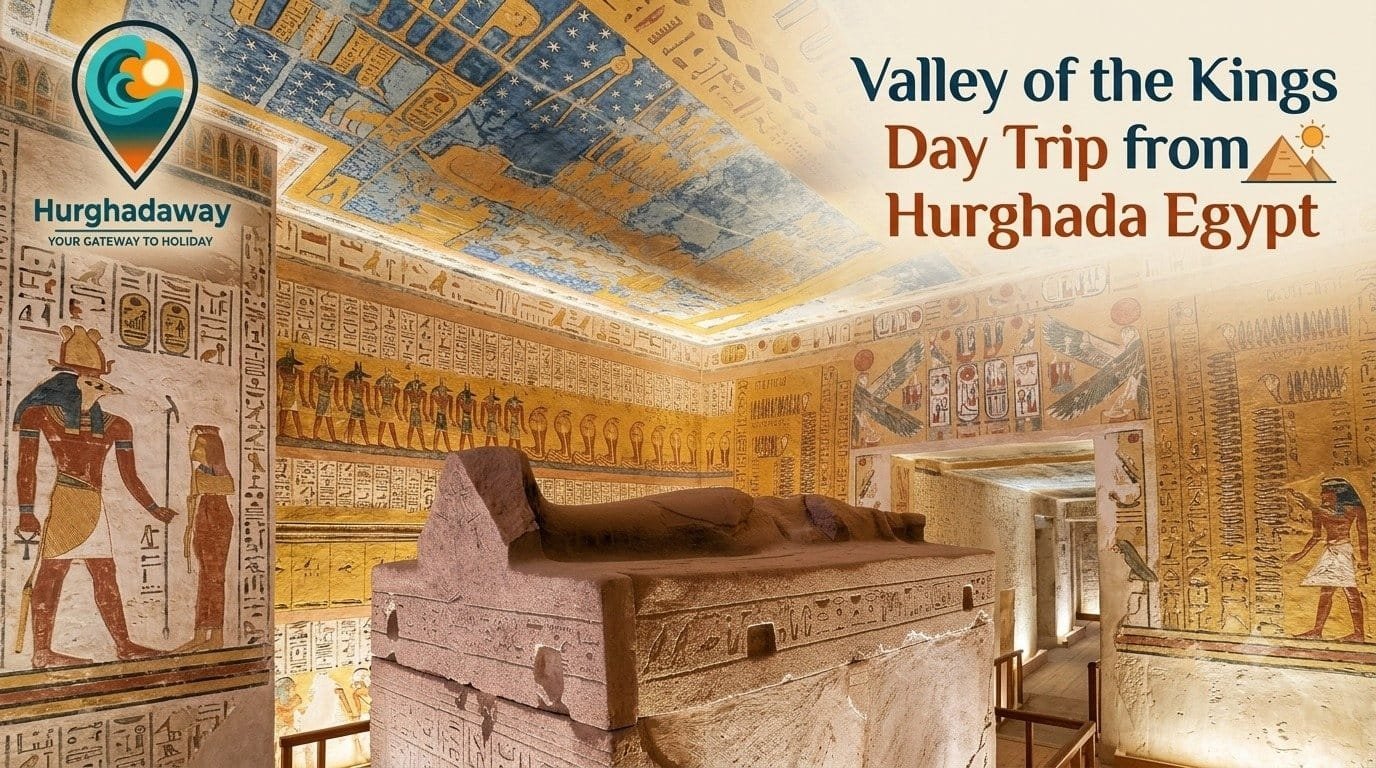
The Valley of the Kings day trip from Hurghada is the most historically significant excursion available from the Egyptian Red Sea coast. Carved into the limestone cliffs of the West Bank of the Nile near Luxor, the Valley of the Kings contains the burial chambers of 63 pharaohs, queens, and nobles of the New Kingdom period (1550–1070 BC) — including Tutankhamun, Ramesses II, Ramesses VI, Seti I, and Merenptah. The tombs are decorated with some of the most elaborate painted hieroglyphic programmes ever created, covering every surface of underground corridors and burial chambers with detailed scenes from the Books of the Dead, the Amduat, and the Book of Gates — religious texts designed to guide the pharaoh’s soul through the underworld to eternal life.
Can you visit the Valley of the Kings from Hurghada? Yes — and the answer surprises many visitors who assume Luxor is out of reach for a day trip. The journey from Hurghada to the Valley of the Kings is approximately 290 to 310 km by road, crossing the Eastern Desert and descending to the Nile Valley — a drive of 3 to 3.5 hours in an air-conditioned private vehicle. Hurghada Way departs at 04:00 AM to maximise time at the sites and returns to Hurghada hotels by 21:00 to 22:00 PM — a long day, but one that most guests describe as among the most powerful travel experiences of their lives.

Ancient Egypt’s Greatest Secret — 3,500 Years Underground, One Day from Your Hotel
The Valley of the Kings day trip from Hurghada brings you face-to-face with the burial chambers of Egypt’s most powerful pharaohs — painted walls, towering hieroglyphs, and the sacred silence of tombs sealed for millennia. Morning: Early hotel pickup and desert crossing to Luxor. Midday: Valley of the Kings (3 tombs with Egyptologist), Hatshepsut Temple, Colossi of Memnon. Afternoon: Traditional Egyptian lunch, optional Nile felucca cruise, return across the desert. Everything arranged door-to-door by Hurghada Way.
Tour Overview — Valley of the Kings Day Trip at a Glance
| Detail | Information |
|---|---|
| Duration | 13 to 15 hours total (hotel pickup to hotel drop-off) |
| Pickup Time | 04:00 – 05:00 AM from your hotel lobby |
| Return | 21:00 – 22:00 PM hotel drop-off |
| Languages | English · Arabic · French on request · Spanish on request |
| Distance | 290–310 km from Hurghada to Valley of the Kings · ~3 to 3.5 hours each way |
| Sites visited | Valley of the Kings (3 tombs) · Hatshepsut Temple · Colossi of Memnon |
| Guide | Licensed professional Egyptologist — private throughout |
| Pickup area | All Hurghada hotels · Sahl Hasheesh · Makadi Bay · El Gouna |
Complete Itinerary — Valley of the Kings Day Trip from Hurghada Hour by Hour


The Valley of the Kings — What You Will See Inside the Tombs
Why the Valley of the Kings Was Chosen
The ancient Egyptians chose the limestone cliffs of the West Bank of Thebes for their royal burial ground for reasons that were both practical and symbolic. Practically: the friable limestone could be carved quickly and deeply into the cliff face, and the remote valley provided natural protection against tomb robbers. Symbolically: the dominant peak of Al-Qurn — the natural pyramid-shaped mountain that rises above the Valley — was sacred to the goddess Meretseger (“She Who Loves Silence”), and the West Bank of the Nile was the land of the dead in Egyptian cosmology, where the sun set each evening and where Osiris, god of the afterlife, was believed to reside.
The pharaohs of the New Kingdom period (1550–1070 BC) abandoned the earlier tradition of pyramid burial and chose instead to hide their tombs in this remote valley while building their mortuary temples at a distance along the Nile edge. The Valley was used for approximately 500 years, housing the burials of rulers from Thutmose I to Ramesses XI — a period that encompasses some of the most powerful and artistically prolific rulers in human history.
What the Hieroglyphic Paintings Mean
The paintings that cover every surface of the royal tombs are not decorative — they are functional. They are the ancient Egyptian equivalent of a religious instruction manual for navigating the afterlife. The texts and images come from a library of ancient religious compositions: the Book of the Dead (spells to protect the deceased on their journey), the Amduat (“What Is in the Underworld” — a detailed map of the 12 hours of the night), the Book of Gates (depicting the guarded gates the soul must pass through), and the Book of Caverns. Your Egyptologist will identify which texts appear in each tomb you enter and explain their meaning and purpose — a level of contextual understanding that transforms the experience from looking at impressive decoration to genuinely understanding what you are seeing.
Hatshepsut Temple and Colossi of Memnon
Queen Hatshepsut — Egypt’s Greatest Female Pharaoh
Hatshepsut ruled Egypt for approximately 22 years (c.1479–1458 BC) as pharaoh — one of the longest and most prosperous reigns of the New Kingdom period. She expanded Egyptian trade (the Punt expedition depicted on her temple walls traded for myrrh trees, ebony, ivory, and live animals), built prolifically across Egypt, and ruled with a political acumen that stabilised and enriched the kingdom. Her mortuary temple at Deir el-Bahari is considered by many Egyptologists to be the finest architectural achievement of the New Kingdom — its elegant colonnades and perfect integration with the cliff face behind it were far ahead of anything produced elsewhere in the ancient world at the same date.
After Hatshepsut’s death, her successor Thutmose III — who may have resented being passed over for power during her regency — had her name and image systematically erased from the temple walls and replaced with his own. For over 3,000 years her identity was unknown. Only in the 19th and 20th centuries, through careful reconstruction of the deliberately damaged reliefs, did Egyptologists piece together who this powerful pharaoh had been — a story your Egyptologist tells at the temple with particular care.
The Colossi of Memnon — Ancient Tourist Attraction
The Colossi of Memnon have been a tourist destination since antiquity. Greek and Roman tourists wrote their names on the statues’ legs (some of these ancient graffiti are still legible today), and the northern statue — which emitted a musical tone at dawn due to heating of the damaged stone by the morning sun — was so famous in the ancient world that the Greek geographer Strabo and the Roman emperor Hadrian both made specific visits to hear it. After a Roman restoration filled the crack in the stone, the sound ceased. The Colossi stand today in their original positions, with the remains of the great Amenhotep III mortuary temple being systematically excavated around their feet by the Colossi of Memnon and Amenhotep III Temple Conservation Project — one of the largest active archaeological digs in Egypt.
Pricing and Packages — Valley of the Kings Day Trip from Hurghada
Hurghada Way offers the Hurghada to Valley of the Kings day trip in two packages — shared group and private tour. Both include hotel transfers, a licensed Egyptologist, entrance fees for three tombs, Hatshepsut Temple, Colossi of Memnon, and lunch. Contact Hurghada Way via WhatsApp for confirmed current pricing on your dates.
Best Time of Year for the Valley of the Kings Day Trip from Hurghada
| Month | Luxor Temp | Crowd Level | Verdict |
|---|---|---|---|
| October – November | 25–35°C | Medium | Ideal — perfect temperature, beautiful light on the temples |
| December – February | 18–26°C | High (peak) | Excellent — comfortable walking temp · book well in advance |
| March – April | 22–35°C | Medium | Excellent — warming up, very good visiting conditions |
| May – June | 32–42°C | Low | Good — hot outdoors · tombs are cool underground · fewer crowds |
| July – September | 38–48°C | Very low | Very hot outdoors · earliest possible arrival essential · best prices |
Related Excursions — More Day Trips from Hurghada
What day trips can you do from Hurghada? Hurghada is one of Egypt’s most versatile holiday bases — combining world-class Red Sea activities with access to the country’s greatest historical sites. Below are the key excursion routes Hurghada Way recommends for building a complete Egypt itinerary.
Historical Day Trips — Luxor · Cairo · Abu Simbel
| Excursion | Duration | Key Sites | Book |
|---|---|---|---|
| Valley of the Kings (this page) | Full day | Valley of the Kings · Hatshepsut · Colossi of Memnon | |
| Karnak Temple Day Trip from Hurghada | Full day | Karnak · Luxor Temple · Avenue of Sphinxes | |
| Luxor Hot Air Balloon + Temple Tour | Full day | Sunrise balloon over Valley of the Kings · Luxor Temple | |
| Pyramids Day Trip from Hurghada by Air | Full day | Pyramids of Giza · Sphinx · Grand Egyptian Museum | |
| Abu Simbel Day Trip from Hurghada by Air | Full day | Ramesses II temple · Lake Nasser · Nubian heritage |
Red Sea Day Trips — Hurghada · Marsa Alam · El Quseir
| Excursion | Duration | Highlight | Book |
|---|---|---|---|
| Giftun Island Day Trip + Snorkeling | Full day | Best coral reef in Hurghada · 2 snorkeling sessions | |
| Mahmya Island Premium Beach + Snorkeling | Full day | Premium managed beach · island restaurant · reef | |
| Marsa Alam & El Quseir Snorkeling Day Trip | Full day | Dugongs · Manta rays · Pristine reef south of Hurghada |
Valley of the Kings → Karnak Temple → Luxor Hot Air Balloon: Three Luxor days covering the full spectrum of ancient Thebes — the royal burial valley, the great temple complex of Amun, and a sunrise balloon flight over the entire West Bank from above. The finest possible way to experience Luxor from a Hurghada base.
Luxor → Cairo → Abu Simbel: The three-day historical arc that covers 5,000 years of Egyptian civilisation. Valley of the Kings for the New Kingdom burial tradition, Pyramids of Giza for the Old Kingdom funerary complex, and Abu Simbel for the Ramesside military empire. All three are day trips from Hurghada — no overnight stays required.
Hurghada → Marsa Alam → El Quseir: For guests who want to pair the Valley of the Kings with a Red Sea extension, Hurghada Way offers the Marsa Alam day trip combining dugong and manta ray snorkeling with the historic Ottoman port of El Quseir — giving you ancient Egypt in the morning and extraordinary underwater Egypt in the afternoon of a different day.


10 Expert Tips for Your Valley of the Kings Visit
Tip 2 — Tell your Egyptologist your interests before entering the Valley. A good Egyptologist tailors the visit to the group’s interests. If you are particularly interested in the Tutankhamun discovery story, the Book of the Dead, the astronomical texts, or the architecture of tomb construction — say so before arriving at the Valley. The guide will prioritise the tombs and explanations that align with what matters most to you.
Tip 3 — Bring a small torch for the tombs. While the tombs have installed electric lighting, the light levels in the deeper chambers are sometimes low and a small penlight torch allows you to examine painted details at close range that the general lighting does not reach. A phone torch works well.
Tip 4 — Wear light, breathable layers. The tombs themselves are cool (approximately 20–22°C regardless of external temperature) but the walking between them on the valley floor is in full sun. A light shirt over a vest, with a sun hat and sunscreen, allows you to be comfortable both outside and inside. Comfortable walking shoes are essential — the valley floor is uneven and the descent into tombs involves steps.
Tip 5 — Arrive at the Valley before 09:00 AM. The Hurghada Way 04:00–05:00 AM departure is specifically timed to arrive at the Valley of the Kings between 08:00 and 09:00 AM — before the majority of day tour groups from Luxor hotels, which typically arrive between 09:30 and 11:00 AM. The difference in crowd level between 08:30 AM and 10:30 AM inside the Valley is dramatic. Early arrival means quieter tombs, shorter queues, and better photographs.
Tip 6 — Do not miss the valley visitor centre. The Valley of the Kings visitor centre contains a remarkable scale model of the entire valley with all 63 tomb locations marked, plus cross-sectional diagrams of the major tombs. Five minutes here with your Egyptologist before entering the tombs gives you a spatial understanding of the entire site that makes the subsequent visits far more coherent.
Tip 7 — Ask about the Tomb of Seti I. The Tomb of Seti I is widely regarded as the most spectacular tomb in the Valley — 137 metres deep, with every surface covered in perfectly executed and brilliantly coloured religious paintings. It requires a separate premium ticket (~$25) and is not always open. If it is open on your visit date, Hurghada Way strongly recommends including it — no other tomb in Egypt matches it for artistic quality. Inform us when booking if this is a priority.
Tip 8 — Eat a proper dinner before the early start. The 04:00–05:00 AM pickup means you will be awake before the hotel breakfast service. Hurghada Way provides a light in-vehicle breakfast — but eating a good hotel dinner the evening before ensures you are properly fuelled for a long and active day. Avoid very heavy eating immediately before the early start as the desert crossing can be uncomfortable on a full stomach at speed.
Tip 9 — Use the return drive for questions. The 3 to 3.5-hour return drive from Luxor to Hurghada is an ideal opportunity for extended conversation with the Egyptologist about what you have seen. Most guests find that the morning’s experiences generate far more questions than could be addressed at the sites. The guide is available throughout the return journey — bring a notebook if you want to record what you learn.
Tip 10 — Consider the Karnak Temple as a second Luxor day trip. The Valley of the Kings and Karnak Temple represent the two complementary halves of ancient Luxor — the royal burial ground and the great temple complex of the god Amun. Together they give a complete picture of New Kingdom Egypt that neither provides alone. Hurghada Way offers both as separate day trips — guests who do both in successive days (or on the same Luxor visit if combined as a two-day trip) consistently describe it as one of the most comprehensive ancient history experiences in the world.
Book Your Valley of the Kings Day Trip Today
Hotel pickup at 04:00–05:00 AM · Private air-conditioned vehicle · In-vehicle breakfast · Licensed Egyptologist guide · Colossi of Memnon · Valley of the Kings (3 royal tombs) · Temple of Hatshepsut · Traditional Egyptian lunch · Optional Nile felucca cruise · All entrance fees included. Instant confirmation. Transparent pricing. No hidden costs. Hurghada Way — your trusted local travel partner in Egypt.
Related tours by Hurghada Way:
Quad Bike Adventure Hurghada Desert Sunset Safari
Can you visit the Valley of the Kings from Hurghada?
Yes — the Valley of the Kings is accessible as a day trip from Hurghada. The Hurghada to Valley of the Kings distance is approximately 290 to 310 km by road via the Desert Road and Qena — a drive of 3 to 3.5 hours each way in an air-conditioned private vehicle. Hurghada Way departs at 04:00–05:00 AM and returns to Hurghada hotels by 21:00–22:00 PM, giving a full day at the West Bank sites. The long day is demanding but consistently described by guests as among the most rewarding travel experiences of their lives.
How much time do you need at Valley of the Kings?
A well-guided visit to the Valley of the Kings with an Egyptologist takes 2 to 3 hours — enough to enter three tombs with full explanation, walk the valley floor between tombs, visit the visitor centre, and photograph the site. Hurghada Way allocates 2.5 hours at the Valley of the Kings within the day trip itinerary. Guests with a deep interest in Egyptology who want to spend longer can request extended time in the private tour format.
How far is Hurghada to Valley of the Kings?
The Hurghada to Valley of the Kings distance is approximately 290 to 310 km by road, via the Desert Road through the Eastern Desert to Qena, then south along the Nile Valley to Luxor. The drive takes 3 to 3.5 hours each way in a private air-conditioned vehicle. Hurghada Way uses well-maintained, comfortable vehicles with experienced drivers who know the Desert Road well. The outward journey is made in darkness (departing 04:00–05:00 AM) and the return in the evening — both are comfortable and smooth.
What is the Valley of the Kings day trip from Hurghada price?
The Valley of the Kings day trip from Hurghada price starts from $65 per person for the shared group tour — including hotel transfers, Egyptologist guide, entrance to three tombs, Hatshepsut Temple, Colossi of Memnon, in-vehicle breakfast, and traditional Egyptian lunch. The Hurghada to Valley of the Kings private tour is quoted per group and additionally includes the Nile felucca cruise. The Valley of the Kings day trip from Hurghada cost is higher than shorter Hurghada excursions, reflecting the 600+ km round trip distance and the full-day Egyptologist service. Hurghada Way offers transparent pricing with no hidden charges — contact us via WhatsApp (+20 1001 363 671) for confirmed pricing.