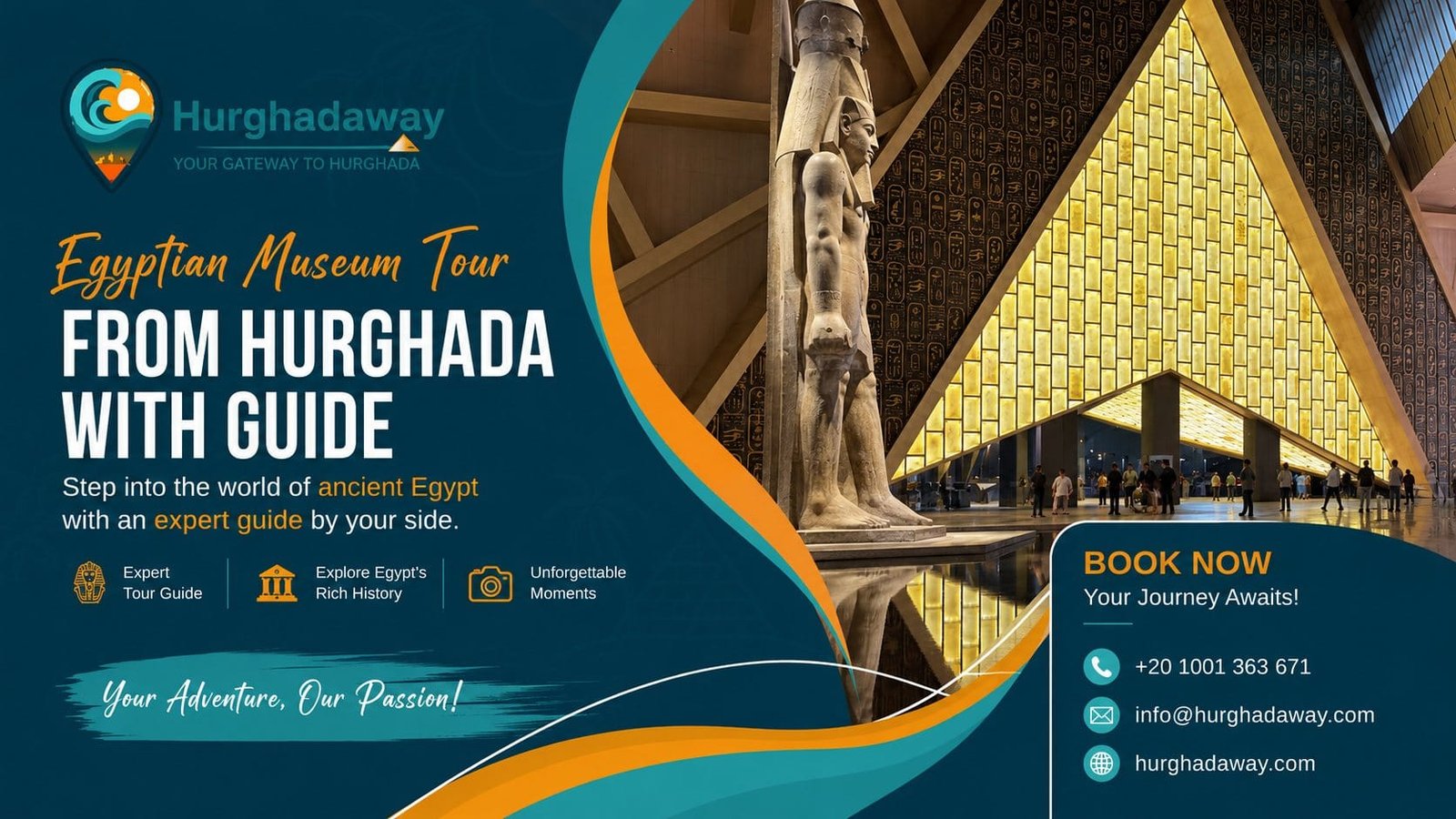
The Egyptian Museum Tour from Hurghada with Guide is the finest single-day immersion in ancient Egyptian civilisation available from the Red Sea coast. Housed in a landmark 1902 neoclassical building on the northern edge of Tahrir Square in Cairo, the Egyptian Museum — formally the Museum of Egyptian Antiquities — contains the world’s largest and most comprehensive collection of ancient Egyptian artefacts: over 120,000 objects spanning 5,000 years of civilisation, from prehistoric stone tools to the complete burial equipment of Pharaoh Tutankhamun. No other museum in the world contains a collection of this depth, this age, and this historical significance.
Combined on the same day with a private guided visit to the Pyramids of Giza — the last surviving Wonder of the Ancient World, located just 14 kilometres from the museum — the Egyptian Museum Tour from Hurghada gives travellers an unparalleled experience of ancient Egypt across two complementary sites: the outdoor monumental architecture of the Giza Plateau in the morning, and the intimate, intellectually rich interior world of Egypt’s greatest museum collection in the afternoon.

Hurghada to Cairo — By Plane, Not By Road. The distance from Hurghada to Cairo is approximately 450 to 460 kilometres by road — a drive of 5 to 6 hours each way, which makes a same-day round trip by car impractical. All Egyptian Museum tours from Hurghada are therefore conducted by domestic flight (approximately 1 hour each way, Hurghada Airport to Cairo International), the only configuration that allows a full day in Cairo and returns guests to their hotels the same evening. Hurghada Way coordinates the complete package — flights, airport transfers, licensed Egyptologist guide, all entrance fees, and lunch — as a single transparent booking.
Trip Overview — Egyptian Museum Tour from Hurghada at a Glance
| Detail | Information |
|---|
| Duration | Full day by air — approximately 16 to 18 hours door to door |
| Pickup Time | 03:30 – 04:30 AM from hotel lobby (flight-dependent) |
| Return | Approximately 21:00 – 23:00 PM hotel drop-off |
| Languages | English · Arabic · French · Spanish · Italian on request |
| Guide Type | Private licensed Egyptologist — Ministry of Tourism certified (Cairo-based) |
| Sites Visited | Egyptian Museum (Tahrir Square) · Royal Mummy Room · Pyramids of Giza · Great Sphinx · Valley Temple |
| Transport | Domestic return flight Hurghada–Cairo (~1–1.25 hrs each way) + private air-conditioned vehicle in Cairo |
| Pickup Area | All Hurghada hotels · Sahl Hasheesh · Makadi Bay · El Gouna |
Complete Itinerary — Egyptian Museum Tour from Hurghada Hour by Hour
1
Early Morning Hotel Pickup and Transfer to Hurghada Airport
03:30 – 04:30 AM
Your Egyptian Museum Tour from Hurghada begins well before dawn. The early departure is essential — this is a full day by air, not a road trip, and the schedule is built around the earliest practical morning flight to Cairo to maximise the time available at both the Giza Plateau and the museum. Our driver collects you from your hotel lobby in a private, air-conditioned vehicle for the transfer to Hurghada International Airport (HRG). Hurghada Way coordinates pickups from all resort areas — El Gouna, Makadi Bay, Sahl Hasheesh, El Dahar, and El Mamsha — with timing calculated backward from your confirmed flight to allow comfortable check-in. Your exact pickup time is confirmed the evening before via WhatsApp once flight tickets are issued.
2
Domestic Flight — Hurghada to Cairo International Airport
05:30 – 06:45 AM (flight time approximately 1 hour to 1 hour 15 minutes)
The trip from Hurghada to Cairo by plane for the Egyptian Museum Tour covers approximately 400 kilometres in around an hour — a journey that would otherwise require 5 to 6 hours of desert driving each way. EgyptAir, Air Cairo, Nile Air, and Nesma Airlines all operate this domestic route daily with multiple departures. Hurghada Way books the earliest practical morning flight, prioritising maximum time in Cairo. From the air as the plane descends into Cairo, passengers often catch their first glimpse of the Giza Plateau from above — the three pyramids visible on the desert edge of the city, a remarkable preview of what awaits on the ground.
3
Airport Arrival and Transfer — Cairo Airport to the Giza Plateau
06:45 – 07:45 AM
On landing at Cairo International Airport, your private Cairo-based Egyptologist guide and air-conditioned vehicle are waiting at the arrivals area — no queuing for taxis, no negotiation with airport touts, no uncertainty. The standard day programme for the Egyptian Museum Tour from Hurghada follows a proven sequence: Giza Plateau first (taking advantage of the morning light and the pre-crowd window), lunch, then the Egyptian Museum in the afternoon. The transfer from Cairo Airport to Giza takes approximately 45 minutes to 1 hour in the early morning — shorter than the same journey at midday or evening.
4
The Pyramids of Giza — The Three Great Pyramids and the Great Sphinx
07:45 – 10:30 AM
The morning is spent at the Giza Plateau — the most visited archaeological site on Earth and the only surviving member of the Seven Wonders of the Ancient World. Your private Egyptologist guide leads a thorough exploration of all three pyramids: the Great Pyramid of Khufu (138.8 metres tall, built around 2560 BC, the tallest man-made structure on Earth for 3,800 years), the Pyramid of Khafre (still retaining its original polished limestone casing near the summit), and the Pyramid of Menkaure. The guide explains the engineering precision, the labour organisation, and the astronomical alignment of the complex with a depth that no guidebook or audio tour can match. From the Pyramids, the route continues to the Great Sphinx — 73 metres long, carved from a single outcrop of bedrock limestone, the largest monolithic statue in the ancient world — and the adjacent Valley Temple of Khafre, built from massive polished granite blocks. The visit concludes at the panoramic viewpoint on the desert ridge where all three pyramids align in a single photographic composition. This is the same Giza experience included in the standard Pyramids Day Trip from Hurghada — guests who wish to focus entirely on the Pyramids without the museum component can book that programme instead.
5
Lunch in Cairo — A Restaurant Near Tahrir Square or with Pyramid Views
11:00 AM – 12:30 PM
Between the Giza Plateau and the Egyptian Museum, lunch is served at a quality Cairo restaurant selected for its food standards and its proximity to the afternoon’s sites. Several of the partner restaurants used by Hurghada Way offer rooftop or panoramic views of the Pyramids — one of the most remarkable lunch settings in the world. The standard menu includes grilled chicken or fish, Egyptian rice and vegetables, fresh salads, flatbread, and soft drinks. Vegetarian options are fully available — inform Hurghada Way at the time of booking. Your guide uses the lunch break to introduce the Egyptian Museum and to highlight the specific artefacts and collections you will visit in the afternoon.
6
The Egyptian Museum — Arrival at Tahrir Square
12:30 – 13:00 PM
The vehicle arrives at Tahrir Square in central Cairo, where the imposing neoclassical facade of the Egyptian Museum dominates the northern edge of the square — its distinctive dusty-pink granite exterior and central dome instantly recognisable from a hundred documentaries and travel programmes. Built in 1902 under the direction of the French architect Marcel Dourgnon, the museum was purpose-built to house Egypt’s exploding archaeological collection following the great excavations of the 19th century. Your guide manages entrance ticketing and navigates you past the entrance queues directly to the highlights of the collection.
7
The Tutankhamun Galleries — The Greatest Archaeological Discovery in History
13:00 – 14:00 PM
The centrepiece of the Egyptian Museum’s upper floor is the Tutankhamun collection — the complete burial equipment of the boy-pharaoh who ruled Egypt from approximately 1332 to 1323 BC and whose tomb (KV62) in the Valley of the Kings was discovered by Howard Carter in 1922 almost entirely intact, making it the most significant archaeological find in the history of Egyptology. The collection fills an entire suite of rooms on the museum’s upper floor and contains over 5,000 individual objects: golden thrones inlaid with semi-precious stones, gilded wooden shrines, alabaster canopic jars, ceremonial chariots, ritual shabtis, linen clothing, food vessels, board games, cosmetic boxes, musical instruments, and — above all — the three nesting coffins and the iconic golden funerary mask of Tutankhamun himself. The mask is made from 11 kilograms of solid gold inlaid with lapis lazuli, carnelian, quartz, obsidian, turquoise, and coloured glass, and is almost certainly the most recognisable archaeological object in human history. Your guide explains every significant object in the Tutankhamun collection — placing each piece in its ritual context, explaining its function in the journey of the pharaoh’s soul through the afterlife, and conveying the extraordinary circumstances of the discovery itself.
8
The Royal Mummy Room — The Preserved Bodies of Egypt’s Greatest Pharaohs
14:00 – 14:45 PM
The Royal Mummy Room of the Egyptian Museum is one of the most extraordinary experiences available anywhere in world travel: a climate-controlled gallery housing the actual preserved bodies of 22 of ancient Egypt’s most famous pharaohs, including Ramesses II (the Great, who ruled for 66 years, built Abu Simbel, and is widely identified as the pharaoh of the Biblical Exodus), Seti I (whose body is considered the finest-preserved royal mummy in existence, with facial features still clearly recognisable after 3,200 years), Thutmose III, Amenhotep II, and Hatshepsut. The Royal Mummy Room requires a separate entrance ticket (included in the Hurghada Way package); photography is strictly prohibited inside and the atmosphere is reverential — visitors are confronted, with an intimacy that no museum display can fully prepare them for, with the actual physical presence of individuals who shaped civilisation more than three millennia ago. Your guide provides context before entering and answers questions after.
9
The Main Museum Galleries — Statues, Stelae, Papyri, and Jewellery
14:45 – 16:00 PM
Beyond the Tutankhamun galleries and the Royal Mummy Room, the Egyptian Museum’s 107 rooms contain an astonishing breadth of objects spanning the full range of Egyptian civilisation. Your guide selects the most significant highlights based on your interests and the time available, typically including: the Narmer Palette (c. 3100 BC — the earliest evidence of a unified Egyptian state, carved in slate), the colossal statues of Amenhotep III and Queen Tiye, the Akhenaten Gallery (featuring the heretic pharaoh’s revolutionary Amarna-period art style), the Animal Mummy Room (cats, ibises, crocodiles, and baboons mummified as offerings to the gods), the extraordinary Jewellery Room (containing golden collars, pectorals, and bracelets from the Middle and New Kingdoms), and the Greco-Roman Mummy Portraits — painted wooden portraits inserted into the linen wrappings of Fayum mummies, combining Egyptian and Roman artistic traditions in one of the ancient world’s most haunting art forms. The museum’s ground floor atrium, lined with monumental statuary, provides the structural framework for the guide’s overview of Egyptian dynastic history.
10
Transfer to Cairo Airport for the Return Flight to Hurghada
16:00 – 17:30 PM
Following the museum visit, the vehicle transfers you from Tahrir Square back to Cairo International Airport, allowing comfortable check-in time ahead of the return domestic flight to Hurghada. Cairo’s afternoon traffic — notoriously heavy on routes from the city centre to the airport — is accounted for in the schedule by your guide and driver, who plan the departure time with local knowledge of the traffic conditions typical for the chosen flight time. Your guide accompanies you to the airport terminal to ensure a smooth handover before the return flight.
11
Return Flight to Hurghada and Hotel Drop-Off
17:30 – 18:45 PM Flight · 20:00 – 23:00 PM Hotel Arrival
The evening domestic flight returns you to Hurghada Airport, where your driver is waiting for the final hotel transfer. Depending on flight schedules and Cairo traffic on the day, hotel drop-off typically falls between 20:00 PM and 23:00 PM. The complete Egyptian Museum Tour from Hurghada is a genuinely long day — 16 to 18 hours from pickup to drop-off — but the combination of the Giza Plateau in the morning, the Tutankhamun collection in the afternoon, and the Royal Mummy Room between them constitutes an experience that guests consistently describe as one of the most extraordinary single days of travel they have ever undertaken.
The Egyptian Museum in Detail — What You Will See and Why It Matters
The World’s Greatest Collection of Ancient Egyptian Artefacts
The Egyptian Museum in Tahrir Square holds over 120,000 artefacts dating from approximately 3100 BC (the unification of Upper and Lower Egypt under the first pharaoh) to the 4th century AD (the end of the Coptic period). No other museum in the world contains a collection of ancient Egyptian material of this breadth, this depth, or this historical significance. The building itself — purpose-built in 1902 — occupies an entire city block and contains 107 rooms arranged in rough chronological order from prehistoric Egypt on the ground floor to the late periods on the upper floors, with the Tutankhamun galleries and the Royal Mummy Room as the twin centrepieces of the collection.
The museum is simultaneously one of the world’s great cultural institutions and one of its most idiosyncratic visitor experiences. Unlike the Grand Egyptian Museum with its modern air-conditioned galleries and multimedia displays, the Egyptian Museum retains the somewhat chaotic, atmospheric quality of a 19th-century collection — objects arranged in dense cases, labels sometimes faded or missing, unexpected discoveries around every corner. This character is part of its appeal, and a private Egyptologist guide who knows the collection deeply transforms the experience from potentially overwhelming to genuinely revelatory.
Key Collections Not to Miss
| Collection / Room | What It Contains | Why It Matters |
|---|
| Tutankhamun Galleries (Upper Floor) | 5,000+ objects including the golden mask, nesting coffins, thrones, chariots, and ritual furniture | The most complete royal burial assemblage ever discovered — and the most famous archaeological find in history |
| Royal Mummy Room (Upper Floor) | 22 royal mummies including Ramesses II, Seti I, Thutmose III, and Hatshepsut | The actual preserved bodies of ancient Egypt’s greatest rulers — an experience of profound historical intimacy |
| Narmer Palette & Predynastic Gallery (Ground Floor) | The Narmer Palette (c. 3100 BC) and prehistoric artefacts | The earliest evidence of a unified Egyptian state — the birth of civilisation in stone |
| Old Kingdom Statuary (Ground Floor) | Colossal statues of Amenhotep III and Tiye, Khafre enthroned in diorite, the Sheikh el-Beled wooden statue | The finest examples of Old and Middle Kingdom royal and private sculpture in existence |
| Akhenaten Gallery (Upper Floor) | Colossal statues and reliefs from Akhenaten’s revolutionary Amarna-period reign | The most dramatic stylistic rupture in 3,000 years of Egyptian art — and the religious revolution that preceded it |
| Jewellery Room (Upper Floor) | Gold collars, pectorals, rings, earrings, and bracelets from the Middle and New Kingdoms | Egyptian goldsmithing at its finest — objects of extraordinary beauty and technical mastery |
| Fayum Mummy Portraits (Upper Floor) | Painted wooden portrait panels inserted into Roman-period mummy wrappings | The ancient world’s most haunting human portraits — Egyptian afterlife tradition fused with Greco-Roman realism |
Private Guide Advantage — Hurghada Way
The Egyptian Museum contains over 120,000 objects in 107 rooms. Without a private guide, most visitors walk through the ground floor, spend 20 minutes in the Tutankhamun galleries, and leave — having seen perhaps 2% of the collection and understood considerably less. With a Hurghada Way private Egyptologist guide, 2.5 to 3 hours at the museum covers the essential highlights with the depth and narrative coherence that transforms a confusing collection of objects into one of the most memorable educational experiences of a traveller’s life. Our guides know specifically which rooms and which objects reward the most time, and they lead you through the museum with precision and passion.
Hurghada to Cairo Distance and Travel Time — By Plane vs by Road
What is the Hurghada to Cairo distance for the Egyptian Museum trip? By road, the distance between Hurghada and Cairo is approximately 450 to 460 kilometres, with a driving time of 5 to 6 hours each way through the Eastern Desert and the Nile Valley. A same-day round trip by car — 10 to 12 hours of driving alone, before any time at the museum or the Pyramids — is not a realistic option for a single-day excursion. Hurghada Way does not offer a road-based day trip to Cairo. All Cairo day trips are conducted exclusively by domestic flight.
What is the Hurghada to Cairo travel time by plane? The domestic flight from Hurghada International Airport (HRG) to Cairo International Airport (CAI) takes approximately 1 hour to 1 hour 15 minutes — roughly the same duration as the Hurghada to Luxor drive. This makes the flight the only practical configuration for a same-day Cairo visit, and the one used by every reputable tour operator in Hurghada.
| Method | Distance | One-Way Travel Time | Practical for Day Trip? |
|---|
| By Domestic Flight | ~400 km (straight line) | ~1 hr – 1 hr 15 min (flight) + ~45 min (transfer) | Yes — only practical method |
| By Road (Car) | ~450–460 km | ~5 – 6 hours | No — 10–12 hrs driving alone, requires overnight |
2026 Pricing and Packages — Egyptian Museum Tour from Hurghada
Hurghada Way offers the Egyptian Museum Tour from Hurghada with Guide in two formats. Both include domestic return flights, airport transfers, private Egyptologist guide, all entrance fees (Egyptian Museum standard ticket + Royal Mummy Room), the Giza Plateau, lunch, and bottled water. Pricing is subject to flight fare availability and seasonal fluctuation — contact Hurghada Way via WhatsApp for confirmed current pricing on your specific travel dates.
Shared Vehicle Package
Egyptian Museum Group Day Trip by Air
Small group sharing flights and a vehicle in Cairo — most cost-effective option with private guide
From $220 / person
Children (3–12): 50% · Under 3: Free (lap-held on flight) · Duration: ~16–18 hrs
Included
✓ Hotel pickup and drop-off in Hurghada (all areas)
✓ Domestic return flights Hurghada–Cairo–Hurghada
✓ Cairo airport transfers and air-conditioned vehicle in Cairo
✓ Private licensed Egyptologist guide (full day in Cairo)
✓ All entrance fees: Giza Plateau (Pyramids, Sphinx, Valley Temple)
✓ Egyptian Museum standard entrance ticket
✓ Royal Mummy Room entrance (included in package)
✓ Lunch at quality Cairo restaurant
✓ Bottled water throughout the day
Not Included
✕ Interior of the Great Pyramid (optional ~$20–25 extra, on-site)
✕ Camel or horse ride at Giza (optional, paid locally)
✕ Gratuities for guide and driver (optional)
Book Group Trip on WhatsApp
Recommended
Private Vehicle Package
Egyptian Museum Fully Private Day Trip by Air
Exclusive private vehicle and guide in Cairo — ideal for couples, families, and discerning travellers
From $260 / person
Best value for 2–4 people · Duration: ~16–18 hrs
Included
✓ Everything in the Group Trip package
✓ Exclusive private vehicle in Cairo for your group only
✓ Fully flexible schedule — museum time extended if needed
✓ Optional: switch to Grand Egyptian Museum on request
✓ Optional add: Saqqara or Islamic Cairo (additional fee)
Not Included
✕ Optional pyramid interior and Giza extras
✕ Gratuities (optional)
Book Private Trip on WhatsApp
Egyptian Museum Tour from Hurghada Price — Key Facts
The Egyptian Museum tour from Hurghada price starts from $220 per person for the shared group package by air, including domestic return flights, all Cairo transfers, private Egyptologist guide, Egyptian Museum standard entrance, Royal Mummy Room, Giza Plateau entrance fees, lunch, and bottled water. The private vehicle package starts from $260 per person and is most cost-effective for groups of 2 to 4. Hurghada Way provides completely transparent pricing — no hidden charges, no on-site surprises beyond the optional extras listed above. Contact us via WhatsApp (+20 1001 363 671) for confirmed pricing on your specific dates, as domestic flight fares vary seasonally.
Best Time of Year for the Egyptian Museum Tour from Hurghada
| Month | Cairo Temp | Museum Crowd Level | Verdict |
|---|
| October – November | 20–30°C | Moderate | Ideal — comfortable at Giza, good museum atmosphere |
| December – February | 12–22°C | High (peak season) | Excellent — cool and comfortable · book flights 2–3 weeks ahead |
| March – April | 18–32°C | Moderate-High | Excellent — warm, good light at Giza, manageable museum crowds |
| May – June | 28–38°C | Low | Good — hot at Giza, but museum is air-conditioned · fewer crowds |
| July – September | 34–42°C | Very Low | Challenging heat outdoors · museum itself remains comfortable · lowest fares |
Local Expert Tip — Hurghada Way
The Egyptian Museum is air-conditioned throughout, which means it is a comfortable visit in any season. The critical time-dependent element of this tour is the Giza Plateau in the morning — which is exposed and has minimal shade. October through April provides the most comfortable outdoor conditions at Giza, and early morning arrival (before the main crowd wave at 10:00–11:00 AM) is always preferable regardless of season. Advance booking matters significantly here because domestic flight seats on the Hurghada–Cairo route sell out quickly during December–February and Egyptian school holidays.
Historical Day Trips — Cairo · Luxor · Abu Simbel
Red Sea Day Trips — Hurghada · Marsa Alam · El Quseir
10 Expert Tips for Your Egyptian Museum Visit from Hurghada
Tip 1 — A private guide is not optional at the Egyptian Museum, it is essential. The Egyptian Museum contains over 120,000 objects across 107 rooms. The labelling is often inadequate, the chronological arrangement is not intuitive, and the sheer volume of material is overwhelming without expert guidance. A private Egyptologist from Hurghada Way transforms the visit from potentially confusing to deeply coherent — selecting the key highlights, providing the narrative thread that connects them, and answering your specific questions throughout. The guide is the most important component of this entire day trip.
Tip 2 — Do not bring a camera bag or large backpack into the museum. Large bags are not permitted in the Egyptian Museum’s main galleries and must be checked into the cloakroom. Bring a small daypack or shoulder bag only, with essentials (water, phone, passport copy, money). Photography equipment beyond a single camera is unnecessary, as the most significant rooms (particularly the Royal Mummy Room) prohibit photography entirely.
Tip 3 — Photography is prohibited in the Royal Mummy Room — accept this gracefully. The Royal Mummy Room prohibits cameras and phones absolutely, and the rule is strictly enforced. Rather than being frustrated by this, approach the Royal Mummy Room as an experience of pure presence — unmediated by a screen or a viewfinder. Many visitors describe the enforced camera-free environment as contributing to the extraordinary power of the experience. Your guide’s introductions before entering each section of the room are the most important preparation.
Tip 4 — Read about Tutankhamun and Howard Carter before your visit. The Tutankhamun galleries are the most famous rooms in the museum, and the story of Howard Carter’s discovery of the tomb in 1922 — the years of patient excavation, the moment of breaking through the sealed doorway, the 3,245 objects catalogued one by one over ten years — is one of the greatest adventure stories in the history of science. Arriving at the museum with this narrative already in your head dramatically increases the emotional impact of seeing the golden mask in person. Your guide will add depth and context, but prior knowledge amplifies the experience.
Tip 5 — Ask your guide specifically about the Akhenaten Gallery. The Akhenaten Gallery on the upper floor contains the colossal statues and revolutionary reliefs from the reign of the heretic pharaoh Akhenaten (Amenhotep IV), who abolished Egypt’s entire pantheon of gods, replaced them with the sun disk Aten, moved the capital, and created an entirely new art style in the space of less than two decades. The story of Akhenaten — his revolution, its complete reversal after his death, and his relationship to his son Tutankhamun — is one of the most dramatic narratives in Egyptian history and is told by the objects in this gallery more powerfully than anywhere else in the museum.
Tip 6 — Wear comfortable walking shoes and light layers. The Egyptian Museum has cool air conditioning in most rooms but can feel warm in the crowded Tutankhamun galleries. Light, comfortable clothing with a layer for the air-conditioned sections, and comfortable shoes for standing and walking on marble floors for 2.5 to 3 hours, is the right preparation for the museum visit.
Tip 7 — The museum shop is worth 10 minutes at the end. The Egyptian Museum’s official shop — located near the main entrance — sells replica artefacts, books, and scholarly catalogues at reasonable fixed prices (no negotiation required). If you want to buy a high-quality replica of the Narmer Palette, a scholarly catalogue of the Tutankhamun collection, or a book on Egyptian hieroglyphs, this is the place. Your guide can recommend specific publications suited to your level of interest.
Tip 8 — Bring Egyptian Pounds for tipping and small purchases. Gratuities for the guide (typically 150–250 EGP per person for a full Cairo day) and driver (100–150 EGP) are most easily paid in EGP. The museum shop accepts EGP and major cards. Optional Giza extras (pyramid interior entry at approximately 750–1,000 EGP, camel rides) are also paid locally. As of June 2026: $1 ≈ 51 EGP approximately.
Tip 9 — Eat a proper breakfast before the 03:30–04:30 AM pickup. The Egyptian Museum Tour from Hurghada is a 16 to 18-hour day. Breakfast is critical — arrange an early hotel breakfast the evening before, or ask Hurghada Way to arrange an en-route food stop. Lunch is included in the programme, but the gap between early pickup and the included lunch is 8 to 9 hours on a physically and intellectually demanding day.
Tip 10 — Book 2 to 4 weeks ahead in peak season. The Egyptian Museum Tour depends on domestic flight availability, which is the binding constraint for the entire programme. Hurghada–Cairo domestic flights sell out during December–February and Egyptian school holidays. Hurghada Way recommends booking 2 to 4 weeks ahead during peak season and at least 1 week ahead at other times. Contact us via WhatsApp as soon as your travel dates are confirmed.


Egyptian Museum Tour from Hurghada with Private Egyptologist Guide
Book Your Egyptian Museum Tour Today
Hotel pickup and drop-off · Domestic return flights · Cairo airport transfers · Licensed Egyptologist guide all day · Pyramids of Giza · Great Sphinx · Valley Temple · Egyptian Museum (Tahrir Square) · Tutankhamun Golden Mask · Royal Mummy Room · Jewellery Room · Akhenaten Gallery · Lunch · All entrance fees included. Instant confirmation. Transparent pricing. No hidden costs. Hurghada Way — your trusted local travel partner in Egypt.
📍 Hurghada, Egypt · 7 days a week
Frequently Asked Questions — Egyptian Museum Tour from Hurghada with Guide
What do reviews say about the Egyptian Museum tour from Hurghada, Cairo and Giza?
Reviews of the Egyptian Museum Tour from Hurghada consistently cite three highlights: the golden mask of Tutankhamun seen in person (described repeatedly as more moving than any photograph prepares you for), the Royal Mummy Room (an experience almost universally described as profound and unforgettable), and the private Egyptologist guide’s ability to make the museum’s vast collection coherent and narratively compelling. Guests who read Pyramids day trip from Hurghada Cairo and Giza tour reviews before booking often choose the Egyptian Museum programme specifically because it adds the mummy room to the Giza and museum combination — giving the deepest possible single-day experience of ancient Egypt.
What is the price of the Egyptian Museum tour from Hurghada?
The Egyptian Museum tour from Hurghada price starts from $220 per person for the shared group package by air, including domestic flights, all Cairo transfers, private Egyptologist guide, Egyptian Museum standard entrance, Royal Mummy Room, Giza Plateau entrance fees, lunch, and bottled water. The private vehicle package starts from $260 per person. Domestic flight fares vary by date and season — contact Hurghada Way via WhatsApp (+20 1001 363 671) for confirmed pricing on your specific travel dates.
How do you get from Hurghada to the Egyptian Museum in Cairo by plane?
The trip from Hurghada to Cairo by plane for the Egyptian Museum tour begins with an early morning domestic flight from Hurghada International Airport (HRG) to Cairo International Airport (CAI), approximately 1 hour to 1 hour 15 minutes. On arrival, a private Egyptologist guide and air-conditioned vehicle wait at the airport arrivals area. The guide accompanies the group for the full day — Giza Plateau in the morning, lunch, Egyptian Museum in the afternoon — before the return flight to Hurghada. Hurghada Way books all flights, arranges all transfers, and confirms the programme in full before departure.
What is the Hurghada to Cairo distance for this tour?
The Hurghada to Cairo distance is approximately 450 to 460 kilometres by road (5 to 6 hours driving each way), making a same-day road trip impractical. By domestic flight, the same distance is covered in approximately 1 hour to 1 hour 15 minutes — the only configuration that makes an Egyptian Museum day trip from Hurghada feasible. The Hurghada to Pyramids distance and the Hurghada to Pyramids travel time follow the same logic: always by air for day trips, never by road.
Is the Tutankhamun golden mask at the Egyptian Museum or the Grand Egyptian Museum?
As of 2026, the golden mask of Tutankhamun is permanently displayed at the Egyptian Museum in Tahrir Square, where it has been housed since it was discovered in 1922. The Grand Egyptian Museum (GEM) near Giza displays the majority of the broader Tutankhamun collection (over 5,000 objects from the tomb), but the golden mask itself remains at the Egyptian Museum in Tahrir Square. This may change as the GEM collection programme develops — Hurghada Way’s guides are always current on which objects are displayed where, and your guide will confirm the up-to-date situation on the day of your visit.
Can the Egyptian Museum tour from Hurghada be done by road instead of by plane?
No — Hurghada Way does not offer a road-based Egyptian Museum day trip from Hurghada. The road distance between Hurghada and Cairo (approximately 450 to 460 km, 5 to 6 hours each way) makes a same-day round trip by car impossible while leaving any meaningful time in Cairo. All Egyptian Museum Tours from Hurghada and all Hurghada to Pyramids day trips are conducted by domestic flight. Travellers who prefer not to fly, or who wish to spend more time in Cairo, should consider an overnight Cairo extension (2 days, 1 night) — contact Hurghada Way to discuss this option.
Is the Egyptian Museum Tour from Hurghada suitable for children?
Yes — children aged 8 and above who have any interest in history, mythology, mummies, or ancient treasure are typically captivated by both the Egyptian Museum and the Giza Plateau. The Tutankhamun collection is particularly compelling for children — golden objects, mysterious rituals, and the adventure story of Howard Carter’s discovery. The Royal Mummy Room is suitable for older children and teenagers (parents should consider whether their specific child is comfortable with preserved human remains displayed in a museum context). The guide adapts explanations for younger visitors. The main consideration for families is the length of the day (16 to 18 hours). Children aged 3 to 12 receive 50% of the adult price; infants under 3 typically fly free as lap-held passengers.